Pay no attention to the post date - just a book-keeping trick; I keep this page updated frequently.
 This is the cover of the 1996 cataloge as distributed in Germany. NOTHING ELSE EVEN COMES CLOSE
If you're looking for tech manuals, try here:
http://archive.kleinbikes.com/us/support/tech_manuals.html
Here's a link to the legal decision on the Klein vs Cannondale Lawsuit:
http://openjurist.org/884/f2d/1399/klein-v-cannondale-corporation
Here's a link to the legal decision on the Klein vs Cannondale Lawsuit:
http://openjurist.org/884/f2d/1399/klein-v-cannondale-corporation

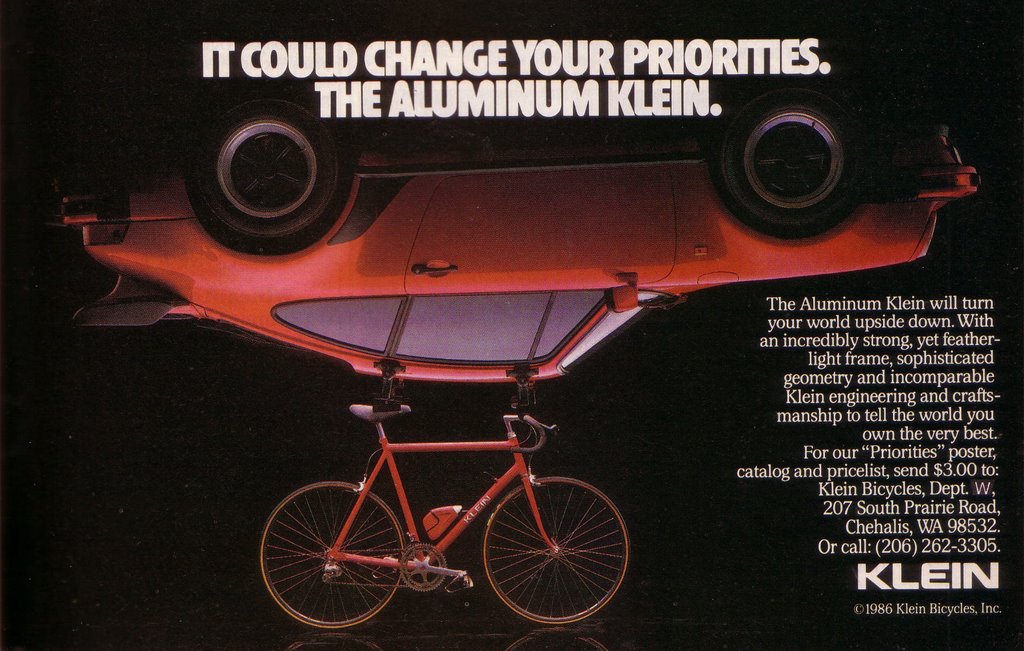 This ad ran for several years in bike racing magazines. I always thought it was clever but what you notice is that Klein needed to convince buyers that aluminum frames could be strong (since their primary competition was steel) - now aluminum frame manufacturers need to convince buyers that aluminum frames can be comfortable and designed to manage fatigue.
I've really only had three road bikes since I got serious about riding in 1984 (Greg Lemond/LA Olympics era). The first was my Ciöcc, purchased as a complete bike in 1985 (died of a broken head tube in 1993), the second was my Eddy Merckx, purchased as a bare frame in 1993 and built up with Ciöcc parts (still going strong but components have all been replaced multiple times), and the third is my Klein, another bare frame built up with Dura Ace parts one bit at a time, completed 2003. I think I wanted a Klein the first time I ever saw one. The first time I remember thinking that was on RAGBRAI XVI, in 1988. I had my Ciöcc, which was de regeur at the time, and another guy on the ride said he really liked it and he had a Klein and I told him I really liked his bike. I told him though that he should have gotten the model with internal cable runs and he said that was a big increase in price. Fifteen years later I'd finally have my Klein with internal cables. Klein production moved from San Martin, CA to Chehalis, WA in 1980 for the less expensive real estate. Trek bought Klein in 1995, but Klein production remained in Chelais through February 2002. Here's a blurb in the Seattle Post-Intellegencer about the loss of jobs. There was a little lag before they got it going again at the Trek facility in Waterloo so there weren't many 2002 Kleins built in Wisconsin. Waterloo bikes were the first ones to have the carbon fiber seat stays (which I still think is a gimmick).

Here's an article about Gary and the sale to Trek and getting out of the business.
Here are some photos I found of Gary himself:
Here are some photos I found of Gary himself:

From the 1990 Catalogue. Mountain bikes were in their heyday.

From the 1991 Catalogue

 And these last two from the 1993 catalogue.
  This is nothing like a real blueprint, but I guess the marketing department thought this made Kleins look more like an engineered product.


So here are the road models I've been able to identify, and a little info on each. Klein (full custom) Klein Team Super Light Klein Stage Klein Tour Klein Team Super Klein Criterium Klein Advantage Klein Performance Klein Quantum Klein Kirsten Klein Quantum Pro Criterium Klein Quantum Pro Road Klein Quantum II Road Klein Aeolus Tri-athlete Road Klein Quantum Pro Klein Quantum Race Klein Q-Pro Klein Q-Pro Carbon Klein Q-Carbon Compact Klein Rêve Most of the info and photos I have here were just copied from various places on the web. If you have any information that would make this a more complete page I'd love to have it - that goes for any photo you have showing something different (or better) than is already here. For instance I'd like to have a definitive list of which bikes had pressed in bottom brackets. I've also got a very small database of serial numbers so it would be nice to expand that if any readers can send in the number, model, and year of their Klein.
 From Jim Langley's Site: 1975 USA Gary Klein displays his welded and heat-treated aluminum frames at the International Bike show. Alan (Italy) and Vitus (France) were producing their lugged aluminum frames around the same time. Cannondale launch their “Aluminum for the Masses” in 1983. If you have the proprietary 1-1/16" headset and want to swap out the bearings to use a standard 1-1/8" steer tube fork, here's Klein's suggestion Basically, they tell you to go to Reset Racing, a German company that offers refit kits... I've heard only good things, but only a few total. Reset also has a good explanation of the difference between MC-1, MC-2, MC-3, and MC-3.1 in their FAQ. So far I've had zero problems with my MC-3 stem or my Klein's internal headset, but if I ever do, and the rest of my frame is still up to it, I'd have no problems going with a kit from Reset. They also have a kit to replace the pressed in bottom bracket if you have one of those. I'd really love to hear more stories if you've used Reset for anything. KleinBikes.com has removed their HISTORY document so I guess it's all up to me now. I do have some old tech manuals as PDFs - just drop me an e-mail if you need one. 1980 Custom frames 1981 Custom frames, line consisted of: Team Super Light Road Team Super Heavy Duty Road Stage Road Stage Tour Road 1986 Custom Frames: Team Super Road Criterium Stage Advantage 1986 Production Frames: Performance Road Quantum Road Kirsten (woman's geometry) 1992 Klein started using oversize seat tube with 31.6mm seat post clamp; slightly larger frame tubes to further reduce weight 1994 Quantum Pro Criterium Gradient 9320 frame tubing, Aeros composite fork Micro dropouts, Mission Control 2 bar/stem combo, gradient chain stays. 1995 Quantum Pro Road Quantum II Road Quantum Road Aeolus Tri-athlete Road 1997 Quantum Race Road – New revision to Quantum Series; 1st year offered as assembled bike Stage Road – New entry level sport/performance design 1999 Mission Control 3 Road stem and clamp; 2001 was the last year of the simple names and proprietary steerer tube size. Only the Quantum Pro gets the superbe Aeros fork. 2001 Klein Quantum 105 2001 Klein Quantum Race Ultegra 2001 Klein Quantum Pro Dura Ace For 2002, Klein adopts the standard 1-1/8" steerer, and starts using ZR9000 aluminum. The Q-Pro model gets carbon seatstays, but the Quantum line still has an aluminum rear end. 2002 Klein Quantum Compact geometry 105 2002 Klein Quantum TT Flat handlebar compact geometry 105 2002 Klein Quantum Race Compact geometry Ultegra 2002 Klein Q-Pro Carbon Standard geometry Dura Ace with carbon rear end For 2003, Trek changes "Quantum" to "Q" and comes up with Team, Race, and Pro designations for component packages. The carbon fiber wishbone seat stays are added to all road frames. The Pro versions get the famous Aeros fork but the compact versions get a different carbon fork. 2003 Klein Q-Carbon Compact geometry Tiagra 2003 Klein Q-Carbon Race Compact geometry 105 2003 Klein Q-Carbon Team Compact geometry Ultegra 2003 Klein Q-Pro Carbon Standard geometry Ultegra 2003 Klein Q-Pro Carbon Team Standard geometry Dura Ace In 2004 we have the standard geometry Q-Pro and the compact geometry Aura. 2004 Klein Q-Pro (V for 105, XV for Ultegra, and XX for Dura Ace) 2004 Klein Aura (V for Tiagra/105, X for 105/Ultegra, and XV for full Ultegra) In 2005 the Aura is replaced by the Rêve, which has a shock dampener in the wishbone seatstay. 2005 Klein Q-Pro (V for 105, XV for Ultegra, and XX for Dura Ace) 2005 Klein Rêve (V for 105, X for Veloce (!), and XX for Dura Ace) In 2006, Klein drops the 105 equipped version of the Q-Pro. 2006 Klein Q-Pro (XV for Ultegra, and XX for Dura Ace) 2006 Klein Rêve (V for 105, and XX for Dura Ace)
If you're trying to identify the model year of a specific frame by its color, this table should help. Of course custom paint jobs were always popular too. One of the other scans on this page somewhere defines names like "linear horizon" et al. Look for the colored tubesets.
 This is the font used on the earliest Kleins, pre 1992. It's got the block letters, close together, I call it Font 1.
  The block font also came in an outline variant - I call it Font 1A. This was used on some early customs, and the 1990 models of Performance, Quantum, and Kirsten (maybe more, I don't know).
 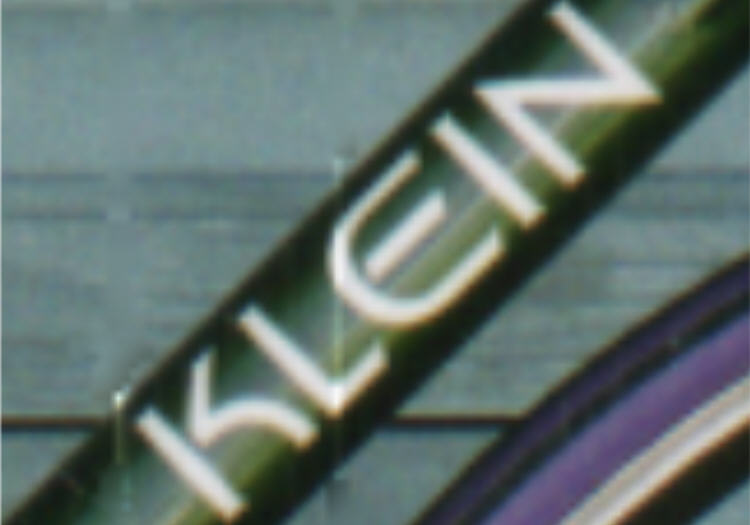 This is the font used on Kleins from 1992 through 1998. Sometimes called the Klingon font, I call it Font 2. The letters are still close together but now the K and E are really curvy. Also, this is not a decal, but the letters were masked off before the color coat was added so you're seeing the prime coat of white - Klein called this "debossing", sort of the opposite of embossing I guess... anyway a really cool effect.
  This is the current font used on all Klein bikes starting in 1999. The letters are blocky and angular and spaced farther apart than ever before. Intriguingly, I've named it Font 3.
 20191104: Klein Owner DAN sends along his new acquisition. He estimates it's a 1981, and I'm pretty sure he's right; an early Chehalis offering. This is a Stage Tour Road, custom made for the original owner. This bike was sold as frame only. It takes the new prize as the oldest bike on my page! Dan reports the serial number is A60 under the dropout. What a beauty.


 This is a Team Super - the oldest Klein I could find a photo of. It has the early font but is a little hard to see in this shot, downtube shifters, non-aero brake cables, no internal cable routing at all, cheap Benotto tape(!), steel fork, extended seat tube, quill stem, and looks like a Super Record rear derailleur. The seat post was still thin like on a steel bike, but they hadn't invented the seatpost collar clamp yet and couldn't use a steel bike's clamp because that bends the metal too much for aluminum so that's what the extended tube is for. Pretty much the only thing setting Klein apart in those days was the big tubes that were still novel. The top tube says "BORON REINFORCED", I hadn't heard of that before. Odd selection of seat post and crank, I guess the owner just liked that orange/gold color. I'm estimating this bike was new in 1985 - brake cables under the tape were pretty standard past then and this bike doesn't have them.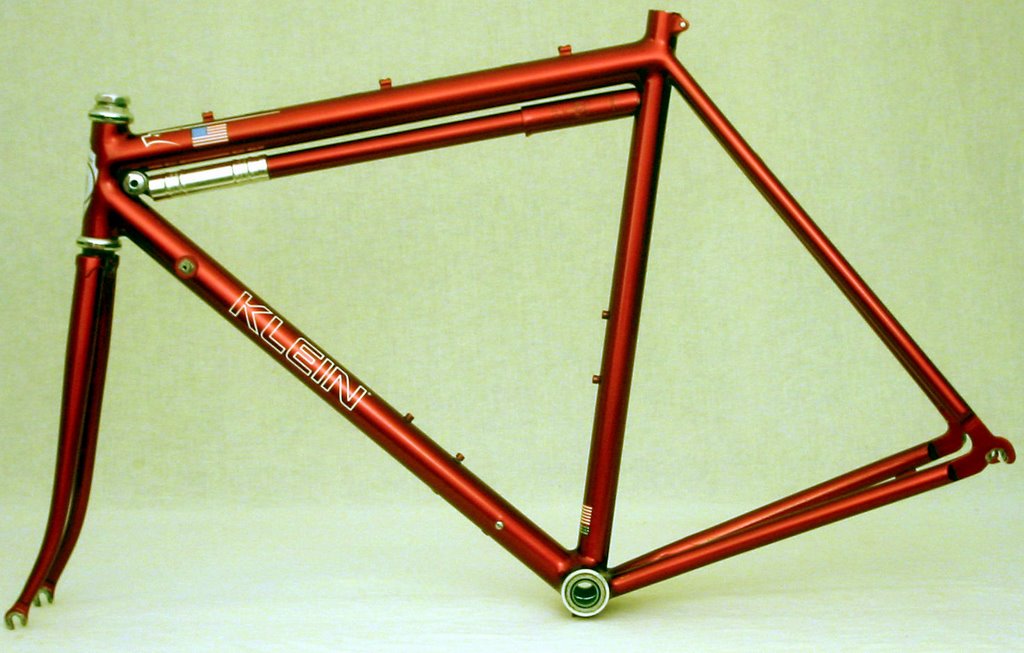
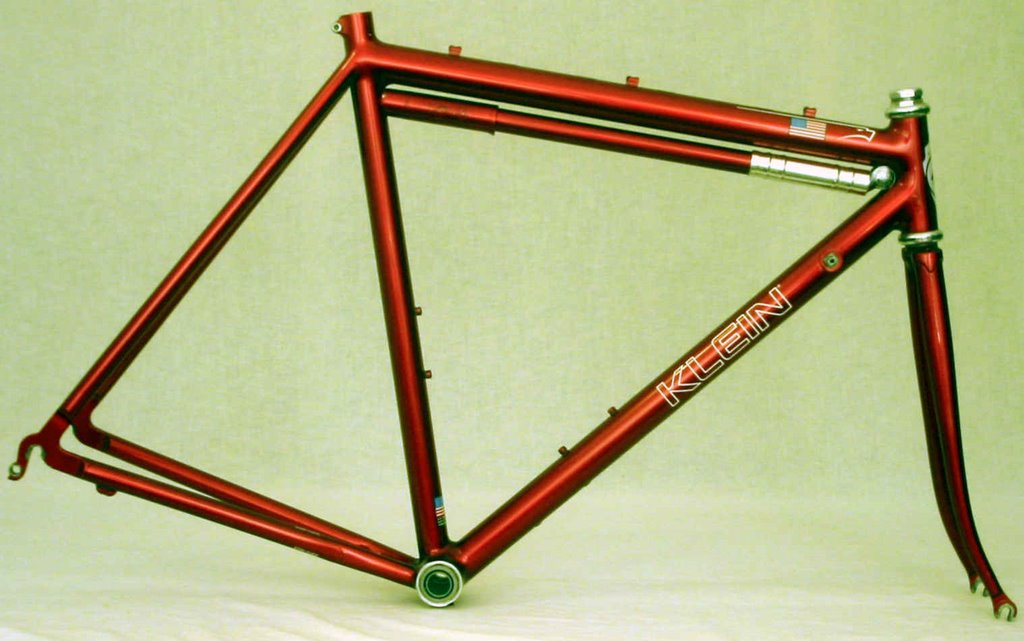
Here's another Team Super custom frame. The owner says it cost him $2300 in 1988.

A page from the 1986 Klein Catalogue. $2,000 for a frame back then was a real high end price tag.
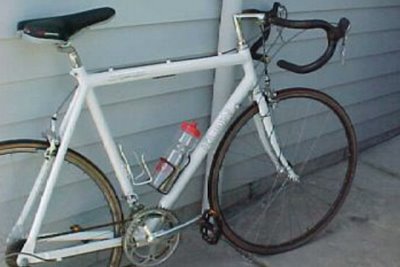
This is an early custom.
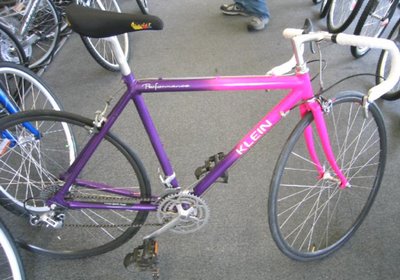 Now here's something a little unusal, the Klein Performance was a touring bike and this one is a beauty - an early example of the interesting paint schemes for which Klein would later become famous. Note the skinny seat post, extended seat tube, L-O-N-G wheel base, bar end shifters, and exposed cable routing. I've heard some people say this is one of the best production touring bikes ever made.
 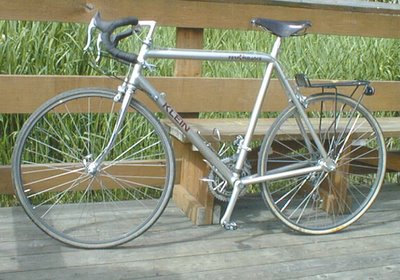 Another Klein Performance - this one looks like it actually got used for touring, judging from the high spoke-count, rear rack, and Brooks saddle. Not an interesting color though, and for some reason this is one of the few bike photos of the non-drive side.
  Here's a 1992 Klein Performance photo from the catalogue - note that the barcon shifters have been replaced with STI levers. No internal cable routing though. I just can't get over how much space there is behind the seat tube!
 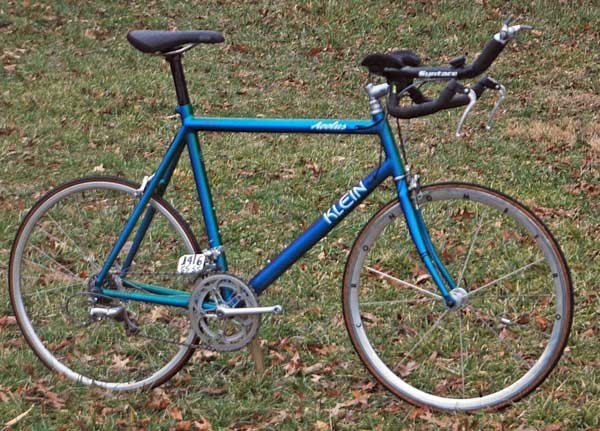 A Klein Aeolus, I always thought that was an odd name but I guess Aeolus was a god of the wind or something so that makes sense for a triathlon bike. Unusual componentry on this one, especially the crank and rear derailleur, "cronometro" wheels might be 650c. I think triathletes want aero shaped tubing so this was never a real popular bike.
 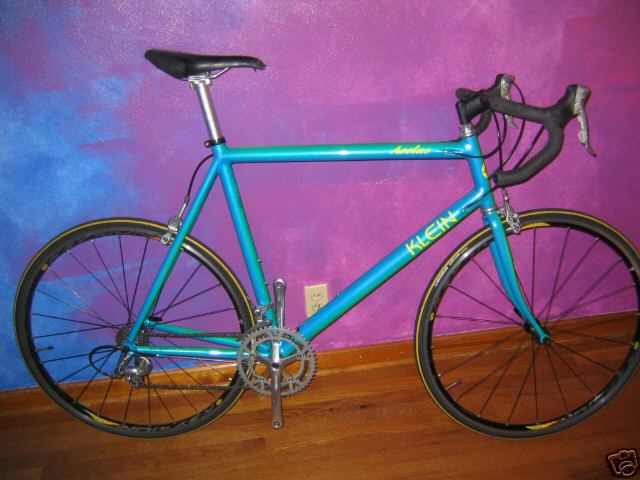 Another Aeolus, not set up for triathlons. What I love about this photo is that the owner painted his wall the "plum crazy" paint scheme found on some Kleins. Both of these Aeoluses have threaded headsets, but this one has a seat tube collar clamp as well.
  Blog reader Harrel sent me this photo of his Aeolus with internal cables, still in use, still looking good.
 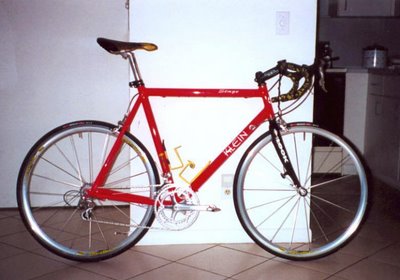 A Klein Stage. If you zoom in you can see the rear facing dropouts, and how they're way bigger than the micro dropouts we have now. Carbon fork and boutique wheels are modifications from the original.
 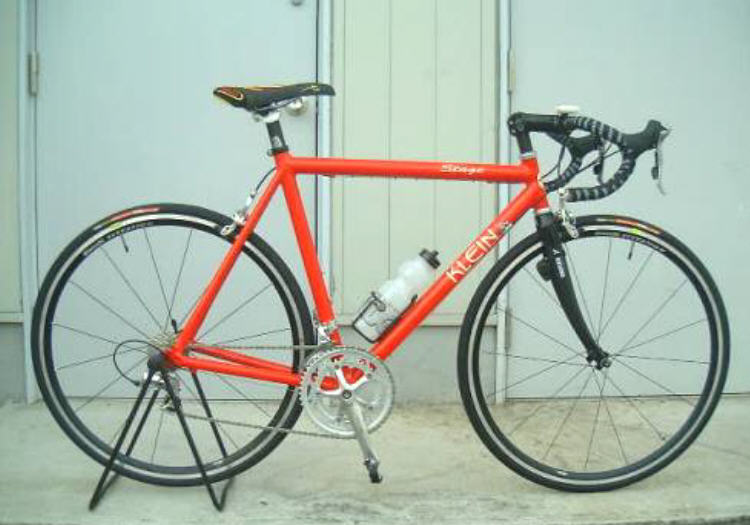 This Stage has been retrofitted with both STI and a carbon fork with threadless headset. Can't tell who made those wheels.
 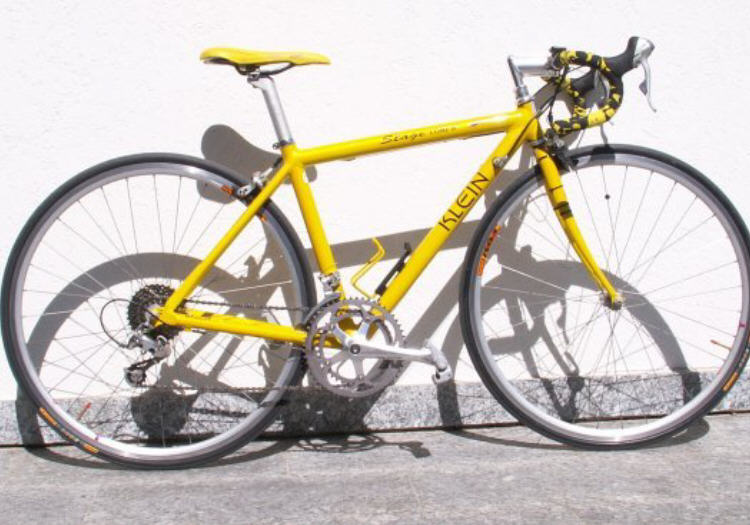 This is a Klein Stage, looks like a custom for a short rider. The STI seems to be a retrofit because it has downtube shifter braze-ons. Steel fork, threaded headset, full sized seatpost and collar clamp, and a good view of the funky, chunky, cantilevered dropout.
A 1992 Klein Kirsten photo from the catalogue. Note that the downtube shifters are on the side because there's not enough room to put them on the top of the downtube.


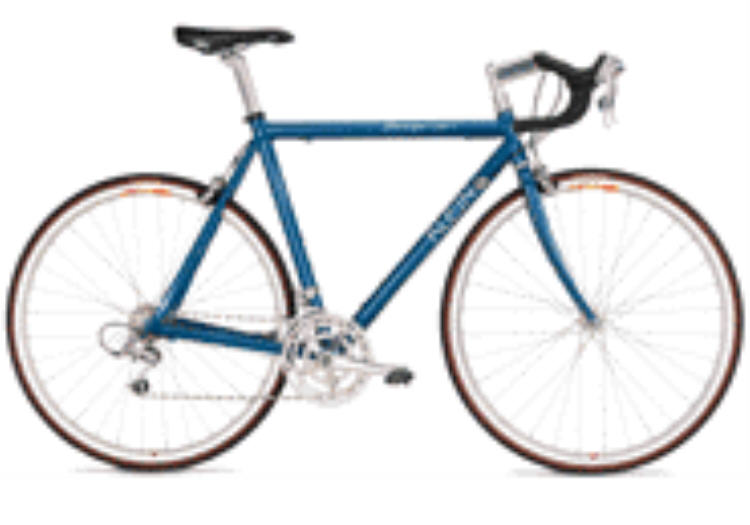 This is a Stage Comp with steel fork, beefy quill stem (Profile?), threaded headset, STI, seat post collar clamp, nice fat seat post, and brake cable routed under the top tube. No boutique wheels and I can't tell about the dropouts. Looks like the Klingon font, about 1992.
  A nice Klein Quantum from the downtube shifter and extended seat tube days... 1989 maybe? An early production model for sure - big fat aluminum tubes were starting to look less odd by this time, and the popularity of skinny steel tubes was waning.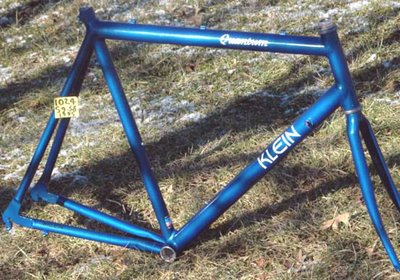
A Quantum frame shows some of the details better... that's GOTTA be a steel fork.


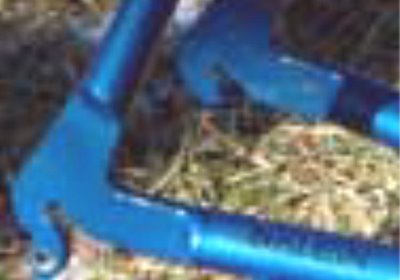
A close up of those chunky dropouts facing the wrong way.

 A special paint job on this Klein Quantum II that's probably a 1995 model - the precurser to the Quantum Race, . This paint scheme is called "Night Storm" and is still available as a custom option. I was surprised they'd been doing this one for so long. We see the appearance of the micro dropouts and internal cable runs, but we still have a threaded headset and a seat tube extension. I think that's a pressed in bottom bracket as well - if you have one of those and want to replace it, Phil Wood has the answer. Also interesting that the KLEIN logo appears on the side of the seat tube - I've never seen that on any other frame, but this was a custom paint job so maybe it's the only one like it. I'm not sure if that's the stock fork or not and I have no idea what's up with those wheels.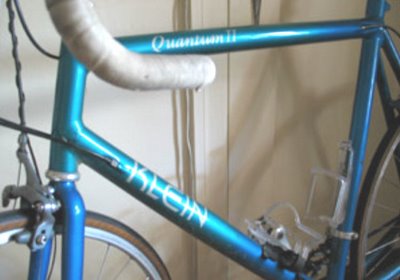
Here's a Quantum II with a standard paint job.


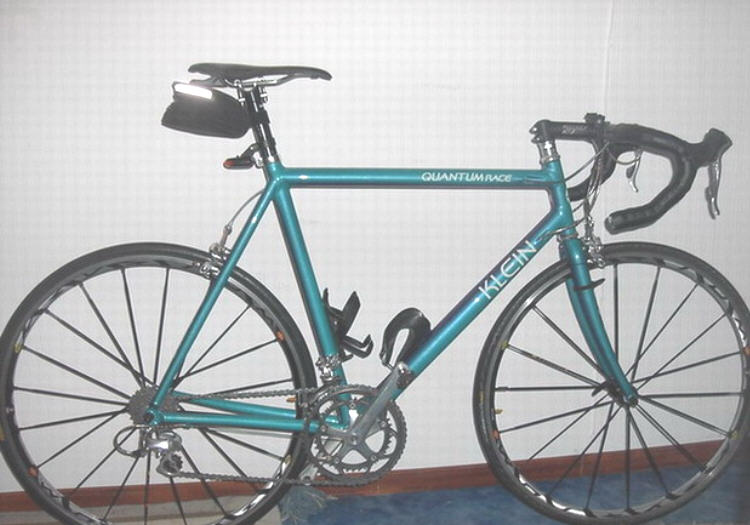 Klein Quantum Race. This one has a different stem - the owner probably used a shim because I'm sure this was during the proprietary steerer size days. Looks like it's still a steel fork too, can that be right? This is probably from 1997 or so.

Couple shots of an unpainted Quantum Pro revealing the weld quality.
 .
.
1998 - This is my Quantum Pro - the photo is from the eBay ad. I got it from a guy in San Anselmo; it was four years old but had never been built up and was in perfect condition (still is pretty much).
Below, a few other bikes with my same 1998 Quantum Pro frame.


 The MC2 Stem had a collet style clamp (no pinch bolts), and an internal brake cable run.
  This 1995 Quantum Pro has an MC2 Stem and the 20th Anniversary custom paint job with Gary's signature - what a beauty!
 I'm pretty sure this Quantum Pro is a 1999 model.
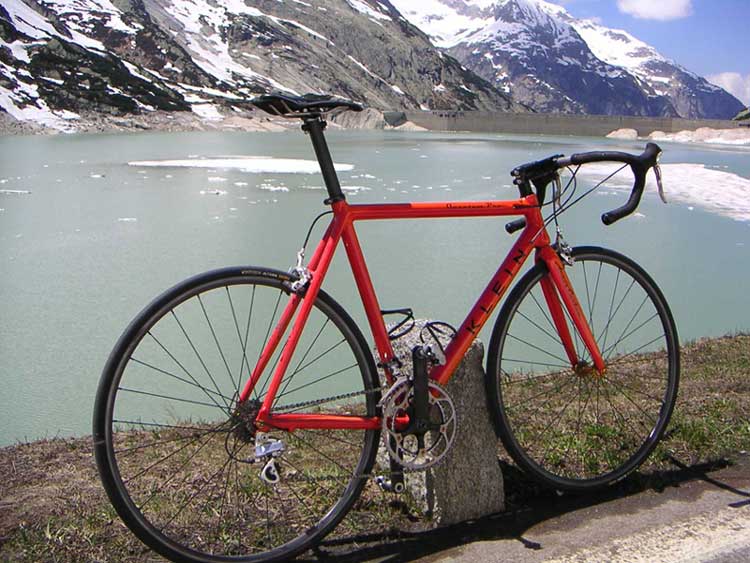
These two orange Quantum Pro's are year 2000 models - MC3 stems with external stem clamp bolts were standard issue that year.
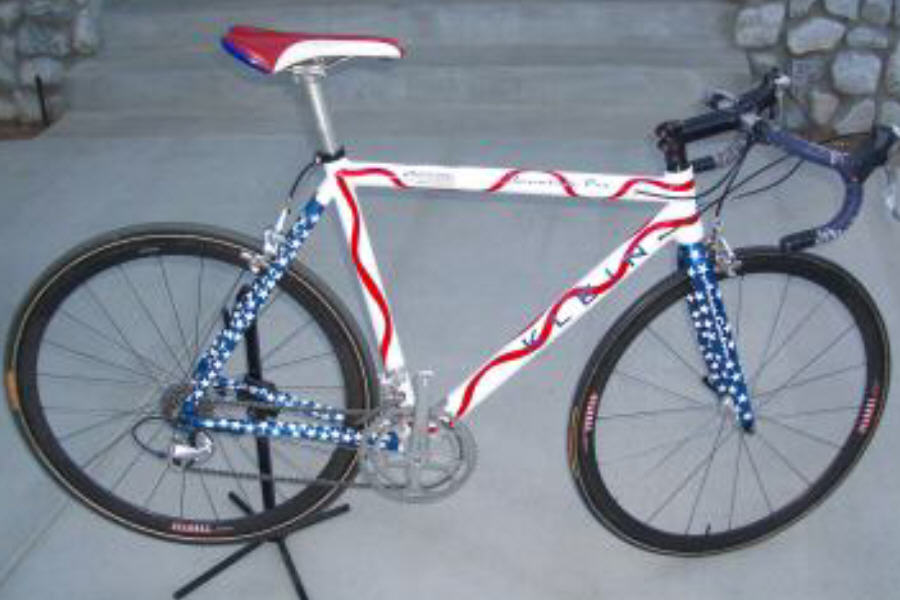
 The Team Gerolsteiner Q-Pro Carbon, used in the 2002 pro season. HERE is a review of the frame on cyclingnews.com. The paint job is called "BUBBLES" and you can still get that as a custom option - look HERE.
 This is a 2003 Q-Pro XX frame with the "Waves" paint option. This frame actually belongs to the guy who designed the Waves paint scheme for a contest Klein had and he got runner up; he's sort of an intenet pen pal of mine and a scenery designer for theatrical plays. Klein adopted the theme as an option and gave him this frame for free! I entered that contest too but my design was pretty boring compared to this. The winner got a whole DA-10 built-up bike.
  In 2004, Klein supplied these Q-Pro XX bikes to Jittery Joe's domestic team. The shifters were still Dura Ace 9-speed because SRAM was the cassette supplier and they didn't make 10-speed cassettes yet. Several other smaller name component sponsors as well. Here's the Cycling News tech review LINK.
Cesar Grajales on his "Lance Dropper".
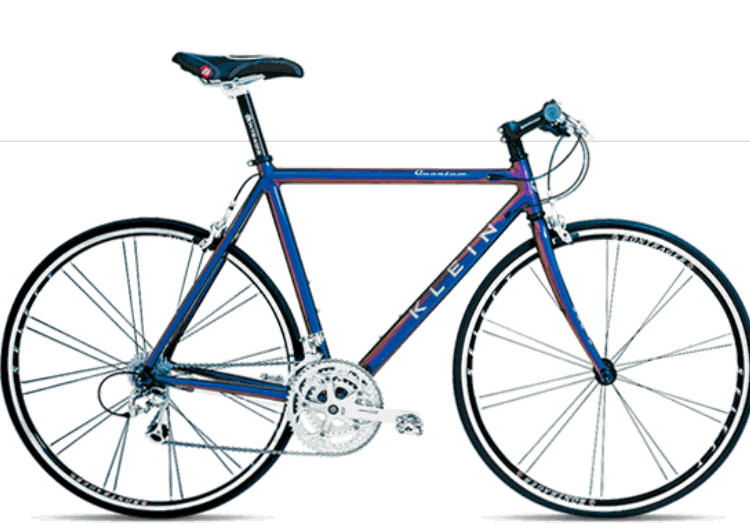 This is a Quantum TT, only offered in the 2002 model year. It was an interesting attempt at appealing to folks who want something between a fast hybrid and a more comfortable road bike. A bunch of other companies made these "flat bar road bikes" around the same time but they never really caught on; maybe the market niche is too small. Besides, it's pretty easy to build up your own road bike with MTB bars and levers if that's what you're after anyway. Nice bike with a triple crank (I guess that's mandatory for MTB shifters) internal cabling and all the other features on the Quantum and Quantum Race. Bontrager wheels have been standard since 2002 models. I've never seen one of these TT's in person.
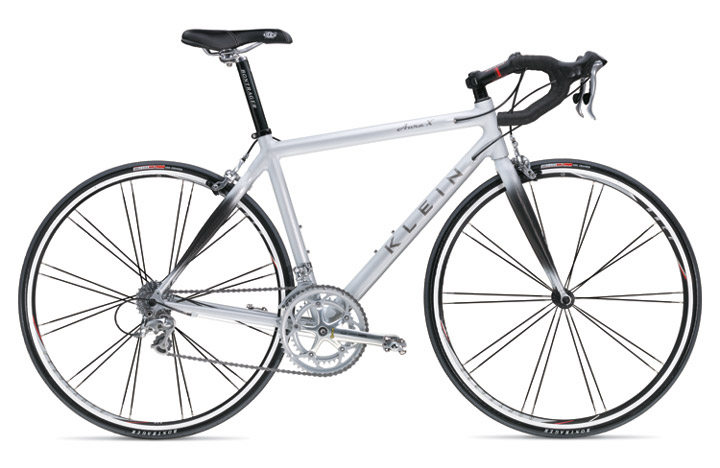
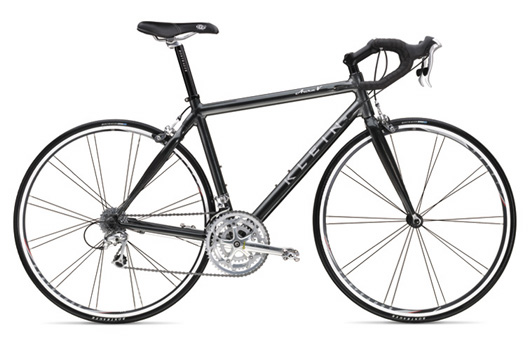 Three Auras - the XV on top, the X and the V on bottom. All the same except for componentry. Klein used to do a lot of compact road frames in their custom days so they knew how to get the geometry right.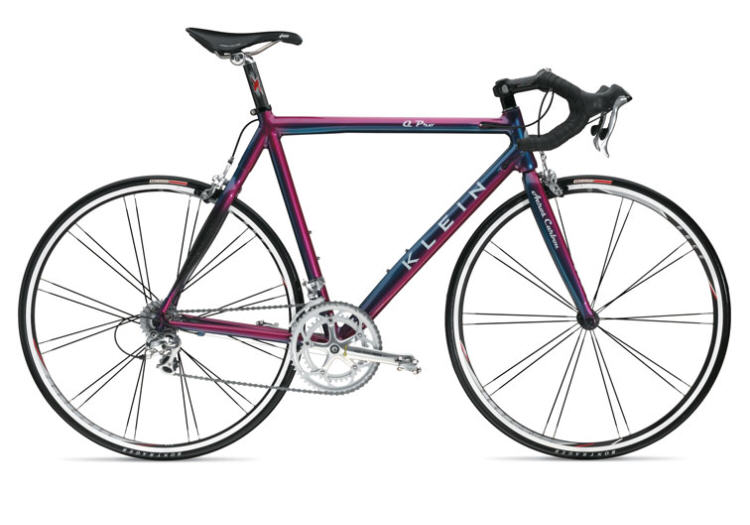

 Q-Pro V (top), XV (middle) and XX (bottom). Nice frames, nicely equipped, a few more concessions to fashion (carbon stays) and standards (headsets). Still special bikes that you can be proud to own, still a little hard to find, still pretty expensive.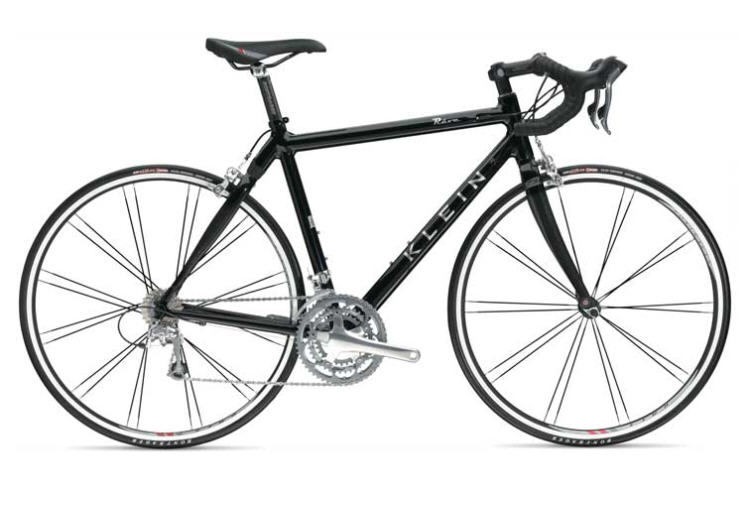
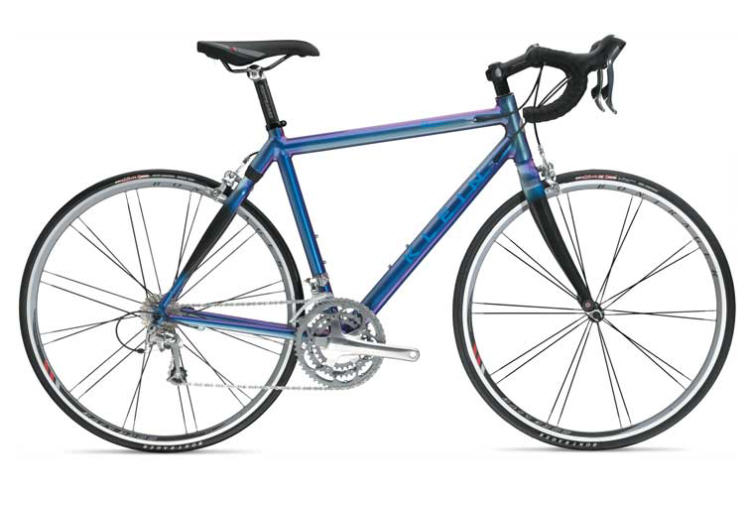 Two Reves from the Klein web page. I first saw these at the San Francisco Grand Prix where Klein had a booth. They had a Reve set up on a trainer with bumpy bits on the roller and another bike without any shock absorber next to it on another trainer with bumpy roller so you could ride both bikes over the bumps and see the difference. I think this was the beginning of the gimmicky stuff Klein started to come out with but I don't know, maybe it does feel better to some people. The forks on Reves are not as beefy and cool looking as the AEROS forks either. Mike J at Chain Reaction did a review of the Reve on his website and he's a better judge of such things than I so check it out HERE. Mike reports that Klein distribution in the USA came to an end in 2007. Apparently Klein in Japan is a huge deal but domestic demand is low. I don't know if Trek killed Klein with its corporate facelessness or if they kept it on life support for the last few years but I'm sure there will always be people who want the kind of build quality and beauty for which Klein is famous; and I think it sad that those people will have to look elsewhere for it in the future. The new Kleins are all carbon fiber and have some satisfied owners, but they don't really hold much appeal for fans of the classic Klein frames.


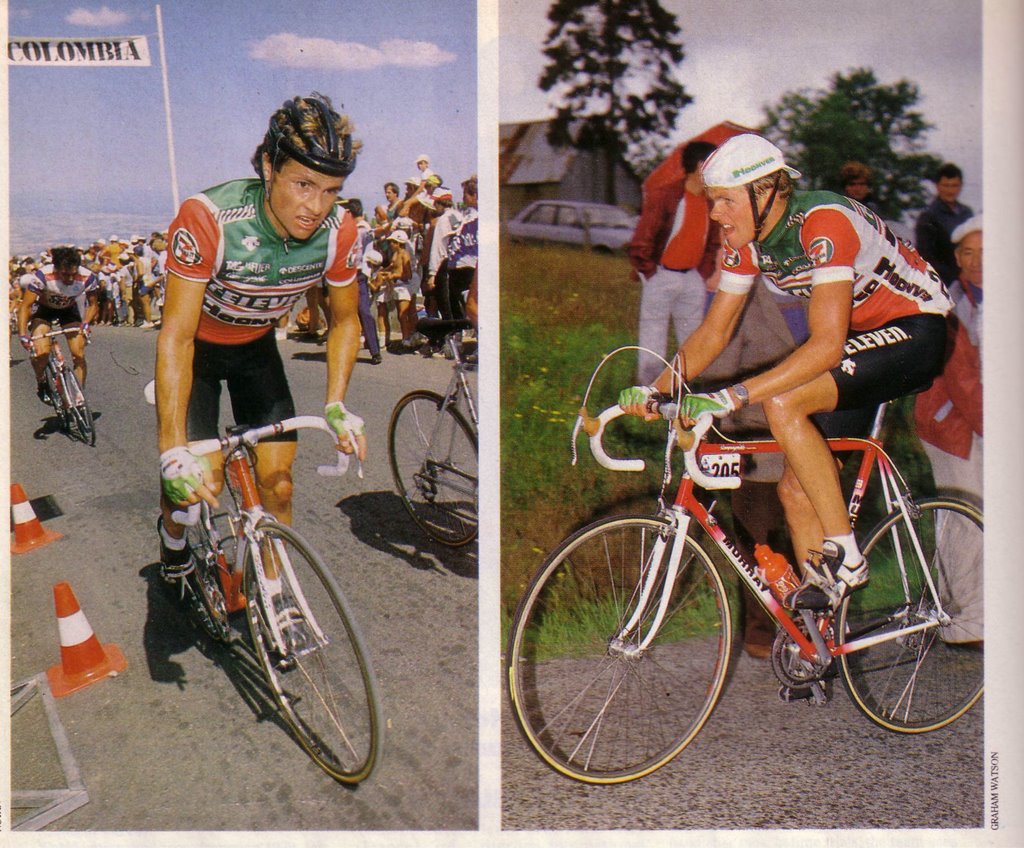
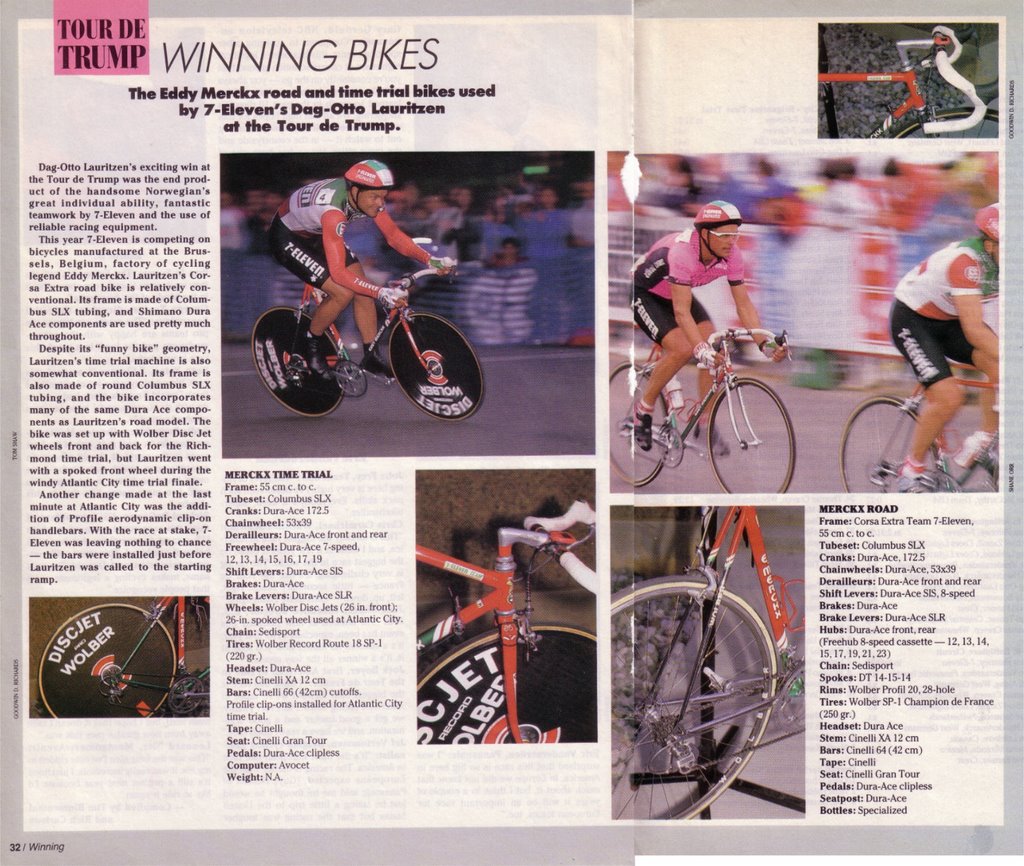
 That's Raul Alcalá in the photo, he joined 7-Eleven in 1986 and the photo is from 1987 so it's either a mistake about the photo, or a mistake about the date (and a change from what they previously reported.